

Tattoo removal

Lasers and colors of the tattoo
If a laser expert checks the chromatic scale he will notice there are very few wavelengths antagonistic to the colors of tattoos. A few have been developed since 1995. With lasers available green and infrared lasers can fade tattoos dark colors, tones closer to red and sometimes green colored tattoos.
Cosmetic tattoos and color mutation
These tattoos placed on the eyebrows, eyelids and lips, have the unique characteristic to mutate in color spontaneously before and after laser treatment. Fortunately the mutation is to the color black, more visible to the Nd-YAG. This mutation becomes an advantage for the total elimination of the tattoo. If the patient has retained a tattoo with light colors he should expect immediate darkening which will be treated in subsequent months with more sessions.
Traumatic Tattoos
They are caused by dirt, gravel, or waste deposits in the skin often after a car accident. These can be faded with Q-switched Nd-YAG laser.
Point tattoos for coal or ink
They can be caused by pencil or markings of medical indications. They all have a very good response because its size and material used. These can clarify completely only with one session after 12 months.
Tattoos in granulation
A tattoo should never be treated in the middle of an active inflammation. The swelling will allow a great chance of pigment particles to pass into the general circulation and an anaphylactic reaction could occur, and even death if it is not treated immediately.
An example of the evolution of a tattoo removal.
It has been shown since 1978 that laser removes tattoos without causing scars or blemishes. However, these complications are often seen with Q-switched lasers. That is why tattoo features; patient and administered amount of energy must be carefully evaluated. We present a case in which we observed a higher clearance tattoo, most noticeable in intervals between sessions over 6 months. For example we presented can be seen as clearance tattoo is more noticeable in intervals between sessions over 6 months.
| Sequence of 5 sessions on the left arm tattoo | |
| Before | 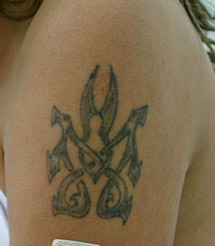 |
| 8 days after the first session There is no great color change |
 |
11 MONTHS AFTER THE FIRST SESSION |
 |
7 MONTHS AFTER THE SECOND SESSION |
 |
A YEAR AND A HALF AFTER THE THIRD MEETING |
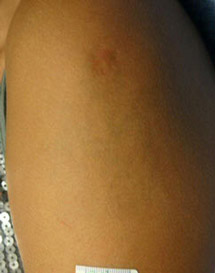 |
6 MONTHS AFTER THE FOURTH SESSION |
 |